Most small business owners know they need SEO. They just don’t fully understand what it does — or why it keeps working years after the initial investment. That’s the gap this article closes.
Search engine optimization isn’t a trick. It’s not a loophole. And it’s definitely not something you do once and forget. Done right, SEO for small businesses is one of the most compounding, cost-efficient growth levers available — especially when you’re competing against companies with advertising budgets that dwarf your annual revenue.
Here’s what you’ll actually get from reading this: a clear, practitioner-tested breakdown of how SEO works for small businesses, what strategies move the needle, and how to stop wasting money on approaches that look good in reports but don’t generate leads.
Why Small Businesses Can’t Afford to Ignore SEO in 2026
There’s a version of this conversation that happened in every industry about fifteen years ago: “Do we really need a website?” The businesses that answered “no” are mostly gone. The SEO conversation today sounds identical — and the stakes are just as high.
Over 68% of all online experiences begin with a search engine, according to BrightEdge. That number hasn’t moved much in years because search is how people think. When someone needs a plumber, a lawyer, a product, or an answer — they search. If your business doesn’t appear in those results, you don’t exist in that moment. A competitor does.
What makes this particularly painful for small businesses is the visibility gap. Large brands invest millions in SEO infrastructure, content teams, and technical optimization. That creates a compounding advantage over time — and for small businesses without a search presence, that gap widens every single month.
But here’s the counterintuitive part: small businesses have an edge that large corporations genuinely can’t replicate. You serve specific geographies. You operate in defined niches. You can build hyper-relevant content and local authority faster than any national chain can pivot to do the same. The opportunity is real — you just need to know where to apply the effort.
The bottom line: Search isn’t a channel you can ignore and expect to remain competitive. It’s the primary way your future customers will find you, evaluate you, and decide whether to contact you.
What SEO Actually Does for a Small Business (Beyond Rankings)
A lot of the confusion around SEO for small businesses comes from focusing on rankings as the end goal. Rankings are a means to an end. What SEO actually delivers — when it’s working — is a predictable stream of qualified traffic from people who are actively looking for what you sell.
Think about that for a second. You’re not interrupting anyone. You’re not paying to show an ad to someone who might be vaguely interested. You’re appearing in front of someone who typed into Google exactly what you offer. That’s the search intent advantage, and it changes how every downstream metric performs.
SEO builds four compounding assets for your business:
- Organic visibility — Your website appears in search results for terms your customers use, without paying per click.
- Brand trust and authority — Ranking on page one signals credibility. Research by Semrush consistently shows that users trust organic results more than paid ads, particularly for service-based decisions.
- Lead quality — Organic visitors typically have stronger purchase intent than social or display traffic. They searched, they clicked, they arrived with a specific need.
- Long-term ROI — Unlike PPC where traffic stops the moment your budget does, SEO compounds over time. A well-optimized page can generate leads for years.
The combination of these four outcomes is what makes SEO structurally different from almost any other marketing investment a small business can make. It’s not the fastest channel — but it’s one of the most durable.
The Difference Between SEO Traffic and Paid Traffic
Paid search (PPC) and SEO serve different functions, and smart businesses use both. But for small businesses working with constrained budgets, understanding the difference shapes where you allocate resources.
PPC delivers immediate traffic with immediate costs. You control the tap — turn up spend, get more clicks; turn it off, get nothing. The economics only work if your margins support continuous ad spend and your conversion rate justifies the cost per click. For competitive industries in the US or UK, a single click can cost $20–$80.
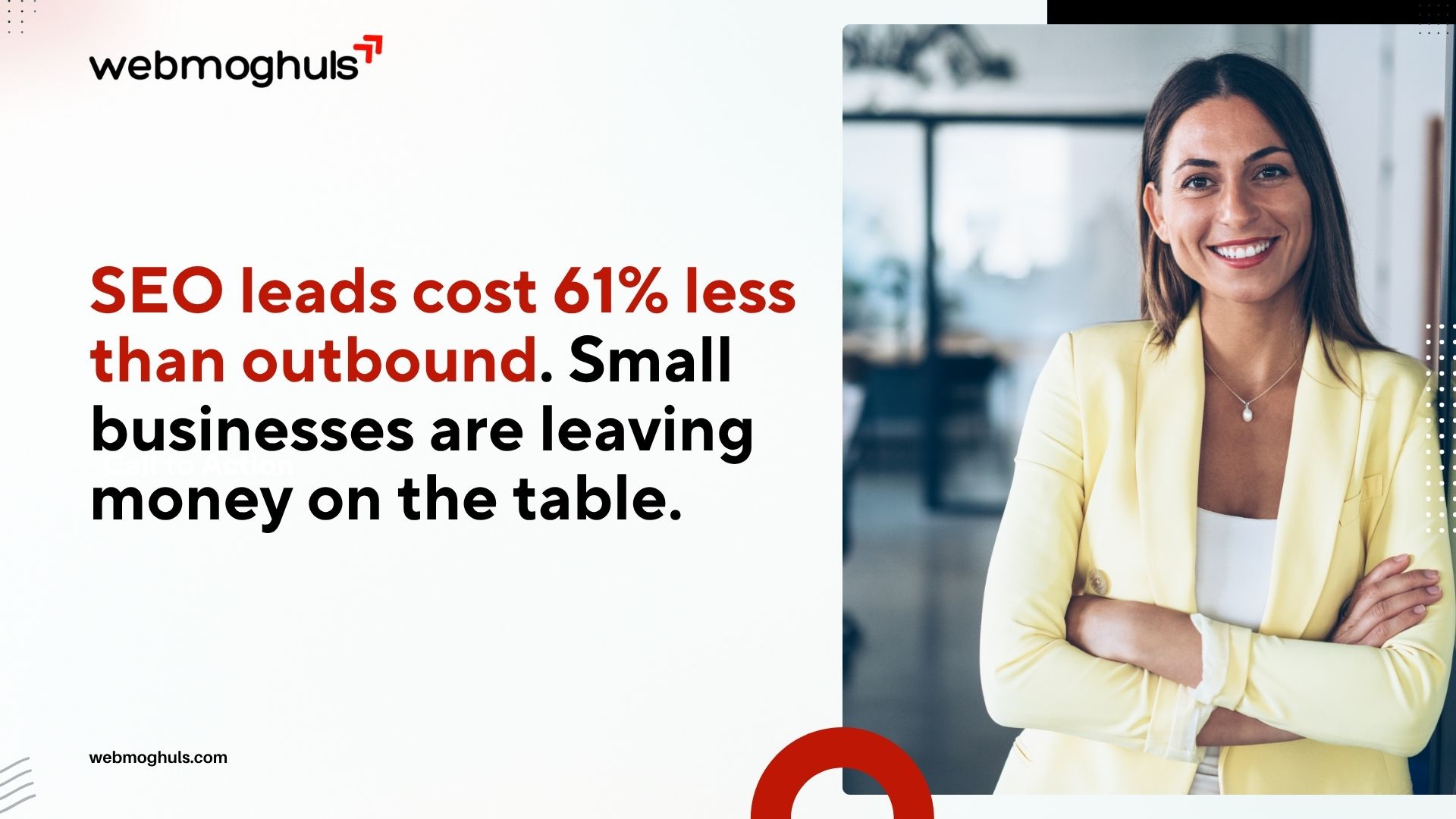
SEO, by contrast, requires upfront investment — in content, technical work, and link building — with delayed but durable returns. A HubSpot study found that inbound leads from organic search cost 61% less than outbound leads over time. That cost advantage becomes more significant the longer your SEO investment matures.
Neither channel is universally superior. But for a small business that needs to build a sustainable growth engine rather than a rent-and-spend marketing dependency, SEO is the more strategic long-term play.
The Core Components of Small Business SEO (And What Each One Does)
SEO isn’t one thing. It’s a system of interconnected components that, when working together, produce visibility, traffic, and leads. Breaking down each component helps you understand where your business currently sits — and where attention is needed most.
1. Technical SEO: The Foundation Everything Else Rests On
Technical SEO refers to the behind-the-scenes health of your website — the signals search engines use to determine how trustworthy, fast, and crawlable your site is. It includes:
- Site speed: Google’s Core Web Vitals are a ranking factor. Pages that load slowly don’t just frustrate users — they rank lower. A one-second delay in mobile load time can reduce conversions by up to 20%, according to Think with Google.
- Mobile responsiveness: Over 60% of searches now happen on mobile devices. A site that breaks on phones is a site Google deprioritizes.
- Crawlability: Search engines need to be able to find and index your pages. Broken links, duplicate content, and poor site architecture create crawl budget waste and ranking suppression.
- HTTPS: Secure sites are table stakes. An unsecured HTTP site is flagged by browsers and carries a ranking disadvantage.
- Structured data (schema markup): Helps search engines understand your content and qualify it for rich results — FAQs, star ratings, service listings, and more.
For small businesses, technical SEO issues are often the invisible ceiling on rankings. You can publish great content and build links — and still underperform if the technical foundation is broken.
A practical way to diagnose your technical health is to run your site through Google Search Console — it’s free, and it directly shows you crawl errors, indexation problems, and Core Web Vitals status for your actual pages. Screaming Frog’s SEO Spider is another tool worth knowing: it crawls your site the way Google does and surfaces broken links, redirect chains, missing meta tags, and duplicate content issues that would otherwise stay invisible until they cost you rankings.
One technical issue that deserves specific attention for small business sites is page speed on mobile. Google’s own research found that as page load time increases from one second to three seconds, the probability of a user bouncing increases by 32%. At five seconds, that probability jumps to 90%. These aren’t abstract numbers — they describe the behavior of your actual potential customers on their phones. A slow site doesn’t just frustrate users; it trains Google to send fewer of them your way.
2. On-Page SEO: Telling Search Engines What Your Pages Are About
On-page SEO is the practice of optimizing individual pages so they clearly communicate relevance for specific search queries. This involves:
- Title tags and meta descriptions: The first thing users see in search results. A well-written title tag can double your click-through rate without any ranking change.
- Header structure (H1–H3): Proper heading hierarchy helps both users and search engines parse your content.
- Keyword placement: Primary and secondary keywords need to appear naturally in your content — not stuffed, but present where they’re contextually appropriate.
- Content depth: Thin content (pages under 300 words with no real substance) underperforms. Pages that thoroughly address a topic earn better rankings and longer time-on-page.
- Internal linking: Connecting related pages on your site distributes ranking authority and helps users navigate deeper into your content.
On-page SEO is the element most small businesses attempt on their own — and most do imperfectly. The gap between a technically correct on-page setup and a genuinely well-optimized page is larger than most realize.
A common mistake is treating on-page SEO as a checklist to run through once. In practice, pages need to be revisited as rankings shift, search intent evolves, and competitors update their content. A page that ranked in position four eighteen months ago may have slipped to position twelve — not because you did anything wrong, but because a competitor updated their content with more depth and fresher data. On-page optimization isn’t a one-time event. It’s an ongoing editorial practice.
Another underappreciated on-page factor is click-through rate (CTR). If your page ranks in position five but earns clicks at the rate of a position-two result — because your title tag and meta description are more compelling than the results above you — Google notices that signal and adjusts. Writing title tags that are keyword-optimized and genuinely interesting to click is a skill. It’s also one of the highest-leverage optimizations most small businesses never prioritize.
3. Off-Page SEO: Building Authority Outside Your Own Website
Off-page SEO primarily means link building — earning references to your site from other reputable websites. Links remain one of Google’s strongest ranking signals because they function as votes of confidence. A site with strong, relevant backlinks signals authority in its domain.
For small businesses, link building often comes from:
- Local citations — Listings in directories like Google Business Profile, Yelp, and industry-specific directories
- PR and media coverage — Being mentioned in local news or industry publications
- Partner sites — Links from suppliers, associations, or complementary businesses
- Content-driven links — High-quality articles that others reference naturally
Quality matters more than quantity. Ten links from respected, relevant sites outperform a hundred links from low-authority directories.
4. Local SEO: The Multiplier for Small Businesses Serving Defined Areas
Local SEO deserves its own category because it operates differently from general organic SEO — and it’s often where small businesses can compete most effectively, even against national brands.
Local SEO for small business focuses on appearing in Google’s “Local Pack” (the map listings above organic results), in local organic results, and in “near me” searches. A BrightLocal study found that 98% of consumers read online reviews for local businesses and 87% used Google to evaluate local businesses in 2023.
The core elements of local SEO include:
- Google Business Profile (GBP) optimization: Your GBP listing is often the first thing a searcher sees — before they even visit your website. Completeness, accuracy, and regular updates directly impact how prominently you appear in local results.
- NAP consistency: Name, Address, and Phone number must match across every online listing. Inconsistency confuses Google and erodes local authority.
- Local content: Pages and blog posts that reference your city, region, and local context signal geographic relevance.
- Review strategy: Volume and recency of Google reviews impact local rankings and conversion rates. Getting more reviews isn’t optional — it’s a competitive necessity.
Our Take — From the Trenches
We work with a number of service-based SMBs across the US and UK — healthcare clinics, legal practices, financial advisors — and one pattern shows up repeatedly: the businesses that invest in local SEO services before they feel they need it consistently outperform competitors who wait until they’re losing leads. Local pack visibility is a compounding asset. Once you hold a position through sustained optimization and review volume, dislodging you costs a competitor significant time and budget. The businesses that start early build a moat. The ones that wait are always catching up.
SEO Strategies for Small Business Growth That Actually Work in 2026
Strategy matters more than tactics in SEO. The tactic landscape shifts — algorithms update, best practices evolve, tools come and go. But the underlying strategy of earning genuine relevance for your target audience has been consistent since Google launched. Here are the strategies that drive results for small businesses in the current environment.
Build Topical Authority, Not Just a List of Keywords
The old approach to small business SEO was to find a keyword, write a page, and repeat. Google’s evolution toward semantic search and topical authority has made that approach structurally insufficient. Today, you need to demonstrate depth — not just presence — on the topics your customers care about.
Topical authority means covering a subject comprehensively across your website, creating interconnected content that signals you’re an expert in a given domain — not just a business that published a few blog posts. A legal firm that covers contract law, employment disputes, business litigation, and related subfields across multiple pages builds topical authority in business law. A single “business law services” page does not.
For small businesses, building topical authority starts with a content pillar approach: identify your two or three core service areas, create comprehensive cornerstone content for each, and build a cluster of supporting articles and pages around them. This architecture signals authority to Google and creates natural internal linking structures that distribute ranking power across your site.
Target Long-Tail Keywords Where Intent Is Clearest
The most competitive keywords in any industry are dominated by large brands. “SEO services” is a three-billion-dollar industry term — competing for it head-on is a resource allocation problem, not a strategy. But “affordable SEO services for small businesses in India” or “best SEO agency for local contractors in Chicago” represents a narrower, more specific intent — and that specificity is exactly where small businesses can win.
Long-tail keywords convert better, face less competition, and attract searchers who are further along in their decision-making. A visitor who searches “how to choose an SEO agency for my plumbing business” is much closer to hiring than one who searches “SEO.” The intent is sharper. The match is tighter.
Effective long-tail keyword research for small businesses starts with what your customers actually say — the questions they ask during consultations, the language in their reviews, the phrases they use in emails. That language, mapped into content, creates the kind of natural relevance that no amount of keyword stuffing can manufacture.
Optimize Your Google Business Profile Relentlessly
For any small business with a physical location or a defined service area, Google Business Profile is arguably more valuable than your website for local search visibility. Yet most businesses set it up once and ignore it.
An optimized GBP listing includes:
- Complete business information: categories, services, hours, service areas
- Regular photo updates (businesses with photos receive 42% more direction requests, per Google’s own data)
- Weekly posts — promotions, updates, events, blog content summaries
- Active review management — responding to every review, positive or negative
- Q&A responses — pre-empting common questions with authoritative answers
The businesses that treat their GBP listing as a living marketing asset — not a static directory entry — consistently outperform competitors in local pack rankings and click-through rates.
Create Content That Answers Real Questions at Every Stage of the Buyer Journey
Content is the engine of SEO — but not all content serves the same purpose. A small business content strategy needs to cover three stages of the buyer journey to maximize organic visibility and conversion:
Top of funnel (awareness): Long-form educational content that answers broad questions in your industry. “What is [service]?”, “How does [process] work?”, “What causes [problem]?” These pages attract early-stage searchers and build brand familiarity.
Middle of funnel (consideration): Comparison content, case studies, and in-depth guides that help a searcher evaluate options. “X vs Y”, “How to choose [service provider]”, “What to look for in [professional]”. These pages attract searchers who are already problem-aware and now evaluating solutions.
Bottom of funnel (decision): Service pages, testimonials, FAQ content, and location-specific pages targeting high-intent keywords. “SEO agency for small business in [city]”, “WordPress website design services for [industry]”. These pages attract buyers.
Most small businesses only have bottom-of-funnel content — their service pages. That means they only appear in searches by people who already know they need help. Expanding to top and middle-of-funnel content dramatically increases the surface area of your organic visibility and captures buyers earlier in their decision process.
Our Take — From the Trenches
Here’s what we’ve observed across dozens of content audits: most small business websites have five to eight service pages and nothing else. No blog. No educational content. No FAQ depth. The result is a site that Google sees as thin — a brochure, not a resource. When we build out content strategies for clients, even a 10-article blog cluster covering their core service area with real depth typically moves organic traffic measurably within four to five months. The content investment pays for itself in lead quality alone. Paired with strong web design that converts the traffic arriving from that content, the ROI case becomes very clear.
Prioritize Page Experience and Conversion Simultaneously
SEO brings people to your site. Your website’s design, structure, and user experience determines what they do when they get there. These two investments are inseparable — optimizing one without the other is like running water into a leaking bucket.
A fast, well-designed, easy-to-navigate website reduces bounce rate, increases time on page, and generates conversions. These behavioral signals also feed back into your SEO performance. Google uses engagement data — particularly Core Web Vitals, dwell time, and bounce rate — as proxy signals for page quality.
This is where UX/UI design becomes an SEO variable, not just an aesthetic one. Clear navigation, intuitive page hierarchy, mobile-first layout, fast-loading pages, and conversion-focused content structure all contribute to the kind of user experience that keeps visitors engaged long enough to become leads.
The businesses that treat website design and SEO as separate workstreams — one for aesthetics, one for search — leave significant performance on the table.
Local SEO for Small Business: How to Dominate Your Geographic Market
If you run a business that serves customers in a specific city, region, or neighborhood, local SEO for small business is where you should focus the majority of your SEO investment. It’s the fastest, most cost-effective path to qualified leads from search — and it levels the playing field against national competitors in a way that generic SEO cannot.
How Local Search Works and Why It’s Different
Local search results are driven by three primary factors, often called the “Local Pack trifecta”: proximity (how close the business is to the searcher), relevance (how well the business listing matches the search query), and prominence (how authoritative and reputable the business appears based on reviews, citations, and links).
Unlike organic SEO, which rewards content depth and backlink authority primarily, local SEO rewards operational consistency, review volume, and geographic specificity. A small business with 200 genuine Google reviews and a fully optimized GBP listing can outrank a national chain with millions in marketing spend — because local search algorithms are designed to surface the most relevant, trusted local option.
Location Pages: Your Secret Weapon for Multi-City Visibility
If your business serves multiple cities or regions, dedicated location pages are one of the highest-ROI investments in local SEO. Each page targets a specific city and the services you offer there — “SEO services for small businesses in Austin” or “WordPress website design in Manchester” — creating location-specific relevance that generic service pages cannot achieve.
Effective location pages aren’t just your service page with the city name swapped in. They include:
- Locally relevant content: references to the business landscape, local challenges, or market context
- Location-specific testimonials or case studies where available
- Local schema markup (LocalBusiness, Service Area)
- Embedded Google Maps
- City and region-specific keyword targeting in headings and body text
Done properly, location pages drive significant local traffic and lead generation — particularly for service businesses competing across metropolitan areas.
Reviews Are Not Soft Marketing — They’re a Ranking Signal
The conversation around reviews in local SEO often focuses on reputation management. That framing undersells the mechanical impact reviews have on rankings. Google uses review signals — volume, recency, sentiment, and response rate — as local ranking factors.
A consistent stream of new reviews signals that a business is active, trusted, and worth surfacing to searchers. Review velocity matters as much as total count. Ten new reviews per month outperforms a business sitting on 100 reviews from three years ago in terms of ranking signal freshness.
Building a repeatable review generation process — asking at the right moment in the customer journey, making it frictionless, and responding to every review promptly — should be treated as an ongoing business process, not a one-time push.
SEO for Small Businesses in High-Intent Industries: What Changes
The core mechanics of SEO are consistent across industries. But the application — what keywords to target, what content to create, how to compete in the local pack — varies significantly depending on what your business does and who your customers are. Here’s how SEO strategy shifts across the industries where small businesses most commonly operate.
Service-Based Businesses: Healthcare, Legal, Financial, and Trades
Service businesses live and die by local search. A plumber in Phoenix, a physiotherapy clinic in Manchester, a financial advisor in Melbourne — all of them primarily need to appear when someone in their geographic area searches for their service. The SEO strategy here centers on local optimization: Google Business Profile, location pages, local citation consistency, and review generation.
But there’s a subtler content opportunity that most service businesses miss. The questions your clients ask before they hire you — “how much does X cost?”, “what’s the difference between X and Y?”, “what happens during a first appointment?” — are search queries with real volume and clear intent. Building content that answers those questions doesn’t just rank; it pre-qualifies visitors. By the time they fill out your contact form, they already understand your process, your pricing range, and what to expect. The conversion rate on that traffic is materially higher than cold traffic from a generic service-keyword landing page.
For regulated industries like legal and healthcare, E-E-A-T (Experience, Expertise, Authoritativeness, Trustworthiness) signals carry extra weight. Google applies heightened scrutiny to what it calls “Your Money or Your Life” (YMYL) content — pages that could affect a person’s health, financial wellbeing, or legal situation. Authorship information, credentials, citations from authoritative sources, and accurate, updated content are not optional in these sectors. They’re baseline requirements for ranking competitively.
eCommerce and Product-Based Small Businesses
Small eCommerce businesses face a structurally different SEO challenge: product and category page optimization at scale, combined with the need to compete against Amazon, large retailers, and increasingly, Google’s own Shopping surface.
The winning strategy for small eCommerce brands is differentiation through specificity. If you sell handmade leather goods, you’re not going to outrank a national leather retailer for “leather wallet.” But “handmade full-grain leather bifold wallet for men” is a long-tail query with genuine purchase intent and dramatically less competition. Expanding your product catalog content to cover the specific attributes — material, use case, audience, occasion — that your best customers search for creates a long-tail traffic base that aggregates into significant organic revenue.
Product page content quality matters more than most small eCommerce operators realize. Unique product descriptions (not manufacturer copy-paste), detailed specification content, user-generated review text, and product-specific FAQs all improve ranking potential and conversion rate simultaneously. The dual benefit — better SEO and better user experience — makes product page content investment one of the highest-ROI activities in eCommerce SEO.
B2B Small Businesses and Professional Services
B2B SEO operates on longer sales cycles and lower search volumes. The terms your prospects search aren’t “hire a B2B company” — they’re specific pain points, capability questions, and industry-specific solution searches. “Cloud migration for mid-size manufacturers,” “contract staffing for fintech startups,” “white-label web design agency” — these are low-volume, high-intent keywords that attract exactly the right decision-makers.
For B2B small businesses, the content priority is thought leadership that addresses the strategic concerns of your buyer. Case studies, industry analysis, process explainers, and comparison content (“What to look for in a [vendor type]”) attract decision-makers who are evaluating options — the consideration stage where most B2B purchase decisions are made.
The conversion path for B2B organic traffic is typically longer than consumer or local service traffic. The goal isn’t usually a direct transaction — it’s a consultation request, a demo booking, or a conversation starter. Designing your content and conversion architecture to reflect that longer buying cycle — including mid-funnel nurture content and email capture — extracts more value from every organic visitor.
Content Marketing as the Engine of Long-Term SEO Growth
Content marketing and SEO are not two separate strategies. They’re the same strategy expressed through different lenses. Content is what earns rankings — because rankings reward relevance, depth, and authority, all of which are expressed through content. Without a content program, your SEO investment is limited to optimizing what you already have, which is a ceiling strategy, not a growth strategy.
What a Small Business Content Program Actually Looks Like
The phrase “content marketing” conjures images of large content teams churning out daily articles. For a small business, it’s far more practical and far more focused. A realistic small business content program might involve:
- One cornerstone piece per quarter: A long-form, comprehensive resource targeting a high-value keyword in your core service area. 2,500–5,000 words, thoroughly researched, built to be the definitive answer to a question your customers ask.
- Four to six supporting articles per quarter: Shorter pieces (800–1,500 words) that answer related questions, target long-tail variations, and link back to the cornerstone piece.
- Regular GBP content updates: Short posts on your Google Business Profile — promotions, seasonal updates, service highlights — that keep your local presence active and fresh.
- One or two location-specific pages per quarter (if you serve multiple areas): Unique, locally-relevant content targeting your service in a specific city.
This isn’t a full-time content operation. For many small businesses, it’s a two-to-four hour per week commitment — or a manageable part of an SEO retainer with an agency that handles content production as part of the engagement.
The Quality Standard That Actually Drives Rankings
Google’s Helpful Content system, rolled out and refined over 2022–2024, has made one thing clear: content written to rank rather than to help users consistently underperforms. The system rewards content that demonstrates real experience and genuine depth — content that someone with actual knowledge of the topic would write, not content assembled by pattern-matching keywords.
For small businesses, this is actually an advantage. You know your industry, your clients, and your market better than any generalist content writer does. The most powerful content you can create draws on that direct experience — the questions clients actually ask, the mistakes you see consistently, the nuances that only practitioners understand. That type of content doesn’t just rank. It builds trust in a way that generic, SEO-template content never will.
A Semrush Content Marketing study found that original research content generates significantly more backlinks than other content types — because journalists, bloggers, and industry publications reference data sources. Small businesses that can compile even basic primary research from their own client experience, industry observation, or survey data create content that earns links naturally, rather than requiring outreach-heavy link building campaigns.
Repurposing Content Across Channels Without Diluting SEO Value
One efficiency play that small businesses consistently underuse: turning long-form blog content into multiple format assets without duplicating content. A 3,000-word blog post on “How to choose an SEO agency for your business” can legitimately produce:
- A LinkedIn post distilling the three most important decision criteria
- A short video walkthrough of the key process steps
- A checklist download (PDF or interactive) that captures email addresses
- A series of social media micro-insights pulled from specific sections
None of these alternatives dilute the SEO value of the original post. They extend the reach of the content investment across channels while the original page continues to compound its search presence. This multiplier effect is one of the structural reasons content marketing produces better long-term ROI than any single-channel approach.
One of the most common frustrations small business owners express about SEO is not knowing whether it’s working. Agencies send reports full of impressions and keyword rankings. But what does that actually mean for your business?
Here’s a framework for measuring SEO performance that connects to outcomes you actually care about: leads and revenue.
Setting Up the Right Tracking Infrastructure
Before you can measure SEO effectively, you need clean data. For most small businesses, that means:
- Google Search Console: Free, essential, and directly from Google. Shows which keywords drive impressions and clicks, which pages are indexed, and what technical issues Google has flagged. If you’re not using Search Console, you’re operating blind.
- Google Analytics 4 (GA4): Tracks organic sessions, user behavior, goal completions, and conversion paths. Set up conversion events for form submissions, phone clicks, and any other lead actions on your site. Without conversion tracking, you can see traffic but not outcomes.
- Google Business Profile Insights: For local businesses, this dashboard shows how often your listing appeared, how many people called directly from search, and how many requested directions — all valuable leading indicators of local SEO performance.
The combination of these three tools — all free — gives most small businesses the data they need to evaluate SEO performance honestly. Expensive third-party reporting dashboards are secondary to having clean, accurate data in these foundational platforms.
The Metrics That Matter for Small Business SEO
Organic sessions: The number of visitors arriving from unpaid search. This is your base traffic metric — it should trend upward over time as your SEO investment matures.
Keyword rankings for target terms: Track 10–20 priority keywords that reflect actual buyer intent. Ranking movements over 90-day periods (not week-to-week) indicate momentum.
Organic conversion rate: Of the visitors arriving from search, what percentage becomes a lead (form submission, phone call, chat inquiry)? This is the metric that connects SEO to business outcomes.
Local Pack visibility: For local businesses, track how often your GBP listing appears and what percentage of impressions generate clicks, calls, and direction requests. Google Business Profile Insights provides this data directly.
Organic revenue or lead value: If you can attribute specific leads or sales to organic search, you can calculate the actual ROI of your SEO investment. For service businesses with $3,000–$10,000 contract values, even two or three SEO-generated leads per month fundamentally changes the economics.
What Realistic SEO Timelines Look Like
SEO does not deliver results in four weeks. This is the expectation gap that causes more frustration than any other single factor in the client-agency relationship.
For a small business starting with minimal SEO foundation, realistic timelines look like this:
- Months 1–3: Technical fixes, on-page optimization, GBP setup and optimization, content foundation. Rankings begin to shift for lower-competition terms.
- Months 4–6: Content cluster development, link building initiation, local citation building. Measurable organic traffic increases begin.
- Months 6–12: Established rankings for core service terms, consistent organic lead flow, local pack presence for primary locations.
- Month 12+: Compounding returns. Rankings for competitive terms, growing content authority, steadily decreasing cost-per-lead.
The businesses that succeed with SEO understand this as a 12-month minimum investment, not a 90-day sprint. The ones that abandon it at month three because “it’s not working yet” typically restart from zero with another agency eight months later — and lose the compounding advantage the initial investment was building.
Affordable SEO Services for Small Businesses: What You Should Expect to Pay
“Affordable SEO” is one of the most searched phrases in this space — and one of the most abused. The word “affordable” has been weaponized by low-quality providers to sell services that deliver reports without results. Here’s how to think about SEO investment as a small business owner.
The Real Cost of Doing SEO Poorly
The cheapest SEO service isn’t $300 per month from an agency that sends you a monthly PDF with keyword rankings and no explanation of what’s actually being done. The cheapest SEO is the kind that works — because the alternatives cost far more.
Consider the math: if your average client value is $5,000 and you convert two leads per month from organic search at a mature SEO investment, your SEO channel generates $120,000 annually. The investment — whether $1,500 or $4,000 per month for a quality small business SEO service — is justified on a single client.
The businesses that treat SEO as a cost to minimize rather than an investment to optimize consistently underperform in organic search. They hire cheap, get poor results, conclude “SEO doesn’t work,” and exit the channel — ceding organic visibility to competitors who understood the ROI.
What Quality Small Business SEO Services Include
A legitimate small business SEO service — not a commodity package — includes:
- Technical SEO audit and ongoing monitoring: Identifying and resolving crawl errors, speed issues, indexation problems, and Core Web Vitals failures.
- On-page optimization: Title tags, meta descriptions, header structure, internal linking, schema markup — applied across your core pages.
- Content strategy and creation: Researched, well-written content targeting your priority keywords — not templated, not AI-mass-generated garbage with your name on it.
- Link building: Outreach-based, relevant, white-hat link acquisition — not directory spam.
- Local SEO: GBP management, citation building, local content, review strategy.
- Monthly reporting: Transparent metrics tied to business outcomes — not vanity metrics dressed up in a dashboard.
- Strategic communication: Regular conversation about what’s working, what’s changing, and where priorities are shifting.
The investment range for quality small business SEO services in the US and UK markets typically falls between $1,500 and $5,000 per month from a reputable agency. Indian agencies with senior-led teams — including Webmoghuls — can deliver equivalent quality at 40–60% of that cost, specifically because their cost structure is different, not because their output is inferior.
Our Take — From the Trenches
We’ve audited dozens of sites that came to us after working with budget SEO providers, and the pattern is consistent: surface-level keyword optimization, thin content, no technical depth, and occasionally, link profiles that actively harm rankings. The damage from poor SEO isn’t always visible immediately — it sometimes takes twelve to eighteen months for a Google algorithm update to surface the penalty. Fixing bad SEO often costs more than doing it right the first time. Our SEO services are built around sustainable, auditable strategies — the kind where every tactic can be explained and defended, and every result can be traced back to specific work.
Why Your Website Design Directly Affects Your SEO Performance
This is the point most small business owners miss: SEO and website design aren’t separate disciplines. They share dependencies that make each one more or less effective depending on the quality of the other.
A poorly designed website undermines SEO in several concrete ways:
- High bounce rate: Visitors who land on a visually unprofessional or confusing site leave quickly. High bounce rates signal poor content relevance to Google and suppress rankings.
- Low mobile usability: Google indexes your mobile site first (mobile-first indexing). A site that performs poorly on mobile fails at the foundational level of Google’s evaluation.
- Slow load times: Poor development practices — uncompressed images, render-blocking scripts, bloated plugins — create the speed issues that Core Web Vitals penalize.
- No clear conversion path: Even perfectly-ranking pages fail to generate leads if there’s no clear next step — no prominent CTA, no visible contact form, no phone number above the fold.
This is why Webmoghuls integrates website design and SEO planning from the start of any engagement. A site that’s designed with SEO architecture in mind — logical URL structure, semantic HTML, clean codebase, fast loading, mobile-optimized — performs better from day one than a site that has SEO bolted on afterward.
The user experience layer — how intuitive, fast, and satisfying your site is to use — is increasingly a proxy for quality in Google’s algorithm. A well-designed site built on a solid technical foundation isn’t just prettier. It ranks better, converts more, and retains visitors longer. That’s why our web design process is inseparable from the SEO strategies we build alongside it.
How to Choose the Right SEO Agency for Your Small Business
The SEO industry has a trust problem. It’s relatively easy to look credible in this space — publish some blog posts, rank for “SEO agency [city],” and show prospects a dashboard of green arrows. What’s harder to fake is sustained client results, transparent processes, and the kind of strategic depth that separates a real SEO partner from a monthly invoice.
Here’s what to actually evaluate when choosing an SEO agency for small business:
Ask About Process, Not Just Results
The first thing any legitimate SEO agency should be able to explain clearly is what they’ll actually do — month by month, in concrete terms — to move your rankings and generate leads. Generic answers like “we’ll optimize your site and build links” should trigger skepticism. Ask for a breakdown of deliverables: how many pages will be optimized, how many pieces of content will be created, what link building methodology is used, and how results will be reported.
Look at the Agency’s Own SEO Performance
An agency that can’t rank its own website for relevant terms is demonstrating the effectiveness of its approach. Check where they rank for keywords like “SEO agency for small business” or “small business SEO services” in their target markets. It’s not a perfect signal — there are legitimate agencies that don’t invest in their own SEO — but it’s a reasonable proxy for capability.
Evaluate Communication and Transparency
This is often the deciding factor once capability is established. Do you communicate directly with the person doing the work, or does everything flow through an account manager who abstracts the relationship? How are strategy decisions made — by you in consultation with a senior strategist, or handed down in a template report?
For small business owners who don’t have time to become SEO experts, the quality of strategic communication from their agency is the primary way they can evaluate whether the work is moving in the right direction.
Understand the Pricing Structure
Flat monthly retainers, hourly rates, and project-based pricing all have different implications for small businesses. Monthly retainers provide predictability and ongoing optimization momentum — they’re generally the appropriate model for long-term SEO. Be wary of agencies that charge heavily upfront for “setup” without clear deliverables or tie long-term contracts to below-market introductory rates with steep escalation clauses.
Final Thoughts
Three things are true about SEO for small businesses, and they’ve been true for long enough that they’re no longer theory — they’re observed outcome:
First, the businesses that invest in SEO consistently — not desperately when leads slow down, but as a sustained quarterly commitment — generate a cost-per-lead advantage that compounds over years. The organic channel becomes their most efficient source of qualified business, and the gap between them and competitors who didn’t invest keeps widening.
Second, SEO doesn’t work in isolation. The quality of your website, the clarity of your service positioning, the depth of your content, the reputation of your business in reviews — these are all variables that determine whether the traffic SEO generates actually converts. A strategy that integrates search optimization with strong web design, conversion-focused UX/UI, and rigorous local SEO outperforms a narrow “just fix the keywords” approach every time.
Third, and perhaps most importantly: the best time to start was twelve months ago. The second-best time is now. Every month your competitors build domain authority, earn reviews, and rank for terms your customers search — that’s compounding advantage you’re not building. SEO is a patient game. The businesses willing to play it consistently win it.
What’s your organic search presence doing for your business right now? If the honest answer is “not much,” that’s worth changing.
Ready to Turn Search Traffic Into Consistent Business Growth?
Most small businesses lose customers every day to competitors who simply appear first in search. Webmoghuls builds SEO strategies that fix that — technically sound, content-driven, and designed to generate leads, not just rankings. We work with SMBs across the US, UK, UAE, Australia, and Canada. Whether you need a full SEO service engagement or a targeted local push, we’ll tell you honestly what it takes and what it costs.
Schedule a free consultation → webmoghuls.com/contact
Frequently Asked Questions
How does SEO help small businesses get more customers?
SEO for small businesses increases your visibility in search results when potential customers are actively looking for your products or services. Instead of interrupting people with ads, SEO positions your business directly in front of high-intent searchers. Over time, this drives consistent organic traffic to your website, generating leads and inquiries from people already motivated to buy — without paying per click.
How long does it take for SEO to work for a small business?
Most small businesses start seeing measurable improvements in organic traffic within four to six months of consistent SEO work. Competitive keyword rankings typically take nine to twelve months to establish. Local SEO results — particularly Google Business Profile visibility — often show improvement faster, within two to three months. SEO is a long-term investment; the returns compound significantly after the first year.
What is local SEO for small business and why does it matter?
Local SEO for small business refers to optimizing your online presence so you appear in location-based search results — including Google’s Local Pack, Google Maps, and “near me” searches. It’s driven by factors like Google Business Profile optimization, local citations, review volume, and location-specific content. For any business serving a defined geographic area, local SEO is often the fastest path to qualified leads from search.
How much should a small business spend on SEO services?
Quality small business SEO services typically range from $1,500 to $5,000 per month in US and UK markets. Indian agencies with senior-led teams — like Webmoghuls — offer equivalent quality at 40–60% lower cost due to structural cost advantages, not reduced output quality. The right budget depends on your market competitiveness, the scope of services required, and the revenue value of a new client. In most cases, two SEO-generated clients per month more than justify the investment.
Can Webmoghuls help my small business rank locally in the US or UK?
Yes. Webmoghuls provides dedicated local SEO services for small businesses across the US, UK, UAE, Australia, and Canada. Our approach covers Google Business Profile optimization, local citation building, location page development, and review strategy — all built around driving qualified local traffic and converting it into leads. We work directly with business owners and marketing managers, with full transparency on strategy and deliverables.
What is the difference between SEO and paid advertising for small businesses?
SEO generates organic traffic through search rankings — the results you don’t pay for per click — and builds long-term visibility that compounds over time. Paid advertising (PPC) delivers immediate traffic but stops the moment your budget does. SEO has a higher upfront time investment with stronger long-term ROI; PPC offers faster results with ongoing costs. For small businesses, the most effective approach typically combines both — using PPC for immediate lead generation while SEO builds sustainable organic authority.